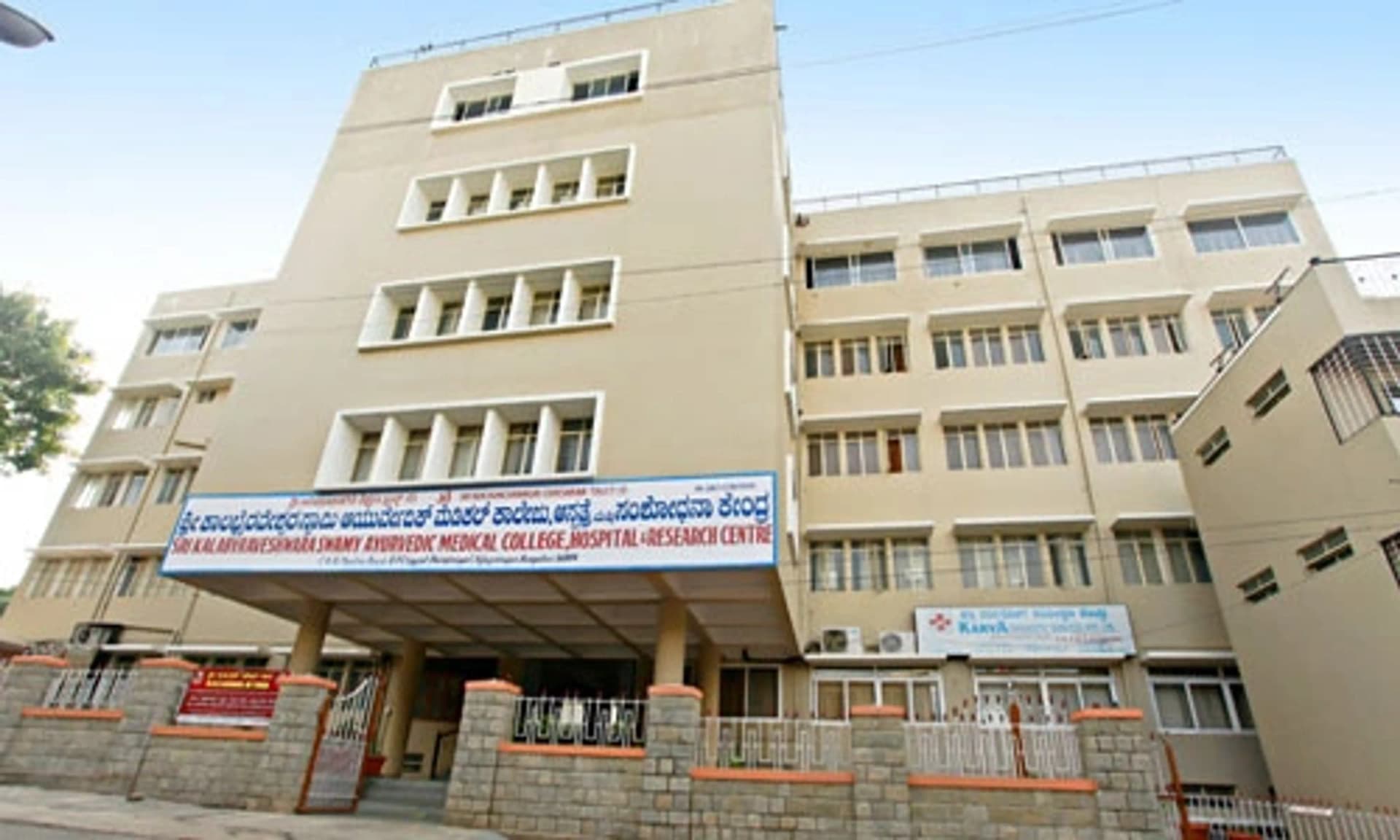
The Sri Kalabyraveshwara Swamy Ayurvedic Medical College and Hospital in Bangalore functions as a respected private Ayurvedic institution which promotes traditional Indian medicine through its educational programs and research activities and its healthcare services. The college established in 1996–1997 through the Sri Adichunchanagiri Shikshana Trust started its operations to restore Ayurveda while fulfilling the increasing need for trained Ayurvedic practitioners.
Rajiv Gandhi University of Health Sciences, Karnataka continues to work with the institution as an academic partner, and the institution has received both official recognition from the Central Council of Indian Medicine (currently known as NCISM) and the Government of Karnataka and Ministry of AYUSH, allowing it to meet national requirements for its academic programs. The institution provides undergraduate (BAMS), postgraduate (MD/MS in Ayurvedic Medicine) and doctoral (PhD) degrees for students, in addition to offering both U&D certifications. The institution's undergraduate, postgraduate, and doctoral programs encompass various teachings offered by practitioners from different certifying bodies and will enable students to gain experience with numerous potential certifications, including Panchakarma, Kayachikitsa, Shalya Tantrum, and Shalakya Tantrum, based on practitioner preference and availability.
The college campus situated in Vijayanagar, Bangalore delivers an academic environment that supports both educational activities and clinical training programs. The college features contemporary infrastructure that includes classrooms with proper ventilation, advanced laboratory facilities, a digital library resource, and an operational Ayurvedic teaching hospital which provides both outpatient and inpatient medical services. The students complete their training through hands-on experience in clinical environments, hospital educational programs, and community health service projects.
The institution follows a complete educational system which combines traditional Ayurvedic teachings with contemporary scientific methods and research activities and medical ethical standards. The college mission intends to develop skilled Ayurvedic practitioners who effectively contribute to healthcare and society through its experienced faculty and advanced infrastructure and dedication to service-based education.
Sri Kalabyraveshwara Swamy Ayurvedic Medical College and Hospital Highlights:
Let's examine Sri Kalabyraveshwara Swamy Ayurvedic Medical College Bangalore's key features:
Particulars | Details |
College name | Sri Kalabyraveshwara Swamy Ayurvedic Medical College and Research Centre |
Popular name | Kalabhairava Ayurveda College Bangalore |
Establishment | 1996-97 |
Institute type | Private |
Location | Bangalore, Karnataka |
Campus size | 11 acres |
Ranking | |
Scholarships | Available via SSP, NSP, and KMDC loans for eligible students |
Affiliated with | Rajiv Gandhi University of Health Sciences, Karnataka |
Recognition |
|
Courses offered |
|
UG entrance test | NEET exam conducted by NTA |
PG entrance test | All India Ayush Post Graduate Entrance Test (AIAPGET) conducted by NBE |
Gender | Co-ed |
Faculty count | 55 |
Student count | 454 |
Hostel facilities | Yes (Male & Female) |
Official website | |
Category | BAMS College in Karnataka |
2. Course Details and Fee Structure:
1) BAMS
Seat intake: 100.
Duration: 5.5 years (including a year-long internship).
Fee structure:
Central Government Fee - 250000/-
State Government Fee - 75000/-
Management Fee - 400000/-
NRI Fee - 600000/- .
2) MD/MS
Specialisations | Duration | GM | OPN | MNG | Seat intake |
MD PANCHAKARMA | 3 years | 125000 | 400000 | 500000 | 6 |
MD KAYACHKITSA | 3 years | 125000 | 400000 | 500000 | 6 |
MS SHALYA TANTRA | 3 years | 125000 | 400000 | 500000 | 6 |
MS SHALAKYA TANTRA | 3 years | 125000 | 400000 | 500000 | 6 |
MS PRASOOTI TANTRA & STREE ROGA | 3 years | 125000 | 400000 | 500000 | 6 |
3. Eligibility, Admission Process, and Documents Required:
Eligibility-
1) BAMS
The aspirants must have completed the 10+2 intermediate exams or equivalent in the respective core subjects such as: Physics, Chemistry, Biology and English language with 50% aggregate.
And the reserved category aspirant ST/SC/OBC aspirants must have scored 40% aggregate in the PCB and English language.
The aspirants must be 17 years old or must have crossed 17 before the 31st December for the admission process.
2) MD/MS
The candidates must have possessed an BAMS Degree from an identified institution that is approved by the National Commission for Indian System of Medicine (NCISM).
The candidates must have completed the one year rotatory residential internship before the prescribed cut-off date.
Candidates should be 17 years old or have crossed 17 years before the admission date.
Admission Process-
1) BAMS
You need to achieve a passing score in the NEET entrance exam to qualify for the exam.
Candidates must register for the counselling process which applies to their situation through state or central counselling.
During the counselling process, students must select SKAMC as their first college choice for admission.
Students must visit the college to complete document verification and admission procedures after receiving their admission allocation.
2) MD/MS
The NEET PG entrance examination needs to be qualified by you.
You must complete your registration process for the NEET PG counselling system.
The procedure of online counselling begins with the reporting process.
The student who receives an SKAMC seat must report to the institution by presenting all necessary documents and making the required payment.
Documents Required-
Those candidates looking to accept this offer of admission into the institution must provide the following documentation for complete registration with the institution:
1) For UG Candidates
Class 10 certificate and mark sheet (for date of birth).
Class 12 certificate and mark sheet.
Admit card.
Scorecard or rank letter.
Provisional allotment letter.
ID proof (Aadhar/PAN card/Driving license/Passport).
Eight passport-size photographs.
Caste certificate (if applicable).
PwD certificate (if applicable).
Fee receipt.
2) For PG Candidates
10th standard certificate as proof of birth.
AIAPGET admit card.
AIAPGET scorecard.
BAMS first, second, and third year exam score sheets.
The institution's head will award a certificate of Internship completion.
Ayush provides the qualifying examination certificate, which is the permanent or provisional BAMS degree certificate.
Valid government identity proofs (Aadhar card/PAN card/Voter ID/Driving license, or Passport).
SC/ST/OBC certificate (if required).
Physically handicap medical certificate (if required).
5. Strengths/Challenges:
Strengths-
The college maintains its affiliation with Rajiv Gandhi University of Health Sciences while receiving recognition from national regulatory bodies to follow standardized Ayurvedic education requirements.
The institution established in 1996–97 has developed a strong academic legacy through its continuous expansion of undergraduate and postgraduate and doctoral programs.
The institution provides multiple academic pathways through its BAMS program and MD/MS programs in various specializations and Ph.D. programs.
The attached hospital with its 350-bed capacity and high patient volume for outpatient and inpatient services provides students with practical clinical training and essential clinical experience.
The academic quality of the institution improves through its dedication to research and innovative work and its efforts to combine traditional Ayurveda with contemporary scientific methods.
The college in Vijayanagar, Bangalore provides students and patients with convenient access to urban transportation services throughout the city.
The school provides complete educational support through its modern facilities which include herbal gardens and digital libraries and specialized treatment units and expert faculty members.
Challenges-
The educational expenses at this private institution will exceed those at government Ayurvedic colleges.
The field of Ayurveda requires professionals to acquire extra skills and clinical training or complete higher education programs in order to gain access to more career paths.
Healthcare sector competition creates obstacles for students who have access to excellent infrastructure because they need specialized skills to succeed in their professional advancement.
Students must take personal responsibility for their research activities and internship experiences and their professional growth beyond their academic studies, etc.
6. Conclusion:
The Sri Kalabyraveshwara Swamy Ayurvedic Medical College and Hospital functions as an accredited institution which promotes Ayurvedic education and research activities and provides Ayurvedic healthcare services. The college provides educational programs which meet national standards because it maintains its affiliation with Rajiv Gandhi University of Health Sciences and receives recognition from National Commission for Indian System of Medicine and other national regulatory bodies. The institution serves as an excellent educational choice for future Ayurvedic practitioners because it offers various academic programs and extensive clinical training through its advanced medical facility and research facilities and holistic educational approach. The institution maintains its academic development base while training students who will make healthcare contributions through their practical learning and study of social healthcare needs despite the existing challenges such as higher tuition costs and competitive career pathways.