The KTG Ayurvedic Medical College and Hospital in Bangalore, Karnataka operates as a private Ayurvedic school which supports Ayurvedic medicine through its educational programs and research activities and medical care delivery. The college started in 2016 as part of the Sri KTG Educational Trust and has developed into an approved Ayurvedic educational institution. The institution receives its educational authorization through Rajiv Gandhi University of Health Sciences while the National Commission for Indian System of Medicine (NCISM) accreditation ensures compliance with national academic requirements.
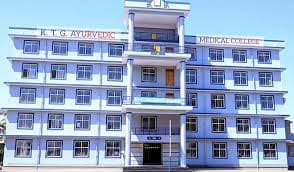
The institution provides the Bachelor of Ayurvedic Medicine and Surgery (BAMS) program which admits 60 students each year. The program combines traditional Ayurvedic teachings with contemporary medical knowledge to help students gain theoretical knowledge and practical clinical skills. The academic infrastructure consists of a four-storey building which houses 14 departments that contain departmental libraries and demonstration rooms and laboratories.
The hospital with its 60-bed capacity and multiple specialized outpatient departments functions as a teaching hospital which provides practical clinical training in Kayachikitsa, Panchakarma, Shalya Tantra and Kaumarabhritya. The institution presents its educational framework through evidence-based learning and ethical practice and community healthcare programs which include outreach activities and preventive health programs. The college develops its Ayurvedic training program through its experienced faculty members and modern educational facilities to produce professionals who can solve present-day healthcare problems while preserving traditional healing methods, etc.
KTG Ayurvedic Medical College and Hospital Highlights:
The salient aspects of the KTG Ayurvedic Medical College, Bangalore are as tabulated below:
Particulars | Details |
College name | KTG Ayurvedic Medical College & Hospital Bangalore |
Popular name | KTG Ayurvedic Medical College |
Establishment | 2016 |
Institute type | Private |
Location | Bangalore, Karnataka |
Campus size | 4 acres |
Ranking | Good |
Affiliated with | Rajiv Gandhi University of Health Sciences |
Approved by | Central Council of Indian Medicines |
Courses offered | UG (BAMS) |
Entrance test | NEET UG |
Gender | Co-ed |
Faculty count | 37 |
Hostel facilities | Yes |
Conducting authority | Karnataka Examination Authority (KEA) |
Official website | |
Category |
2. Course Details and Fee Structure:
BAMS
Seat intake: 60.
Duration: 4.5 year + 1 year Internship.
Fee structure:
All India Quota Fee - 2,50,000/-
State Quota Fee - 75,000/-
Management Quota Fee - 4,00,000/-
NRI Quota Fee - 6,00,000/- .
3. Eligibility, Admission Process, and Documents Required:
BAMS
Eligibility-
Candidates need to complete 10+2 or its equivalent exams which include Physics and Chemistry and Biology as their main subjects.
Candidates need to pass the NEET UG exam to meet the requirement for the program.
The applicant must reach the required minimum age which official authorities have set according to their established rules.
Admission Process-
Candidates must first appear for and qualify the NEET-UG examination which is mandatory for admission.
NEET merit determines admission eligibility according to regulatory body guidelines established by NCISM, AYUSH, and RGUHS.
Eligible candidates must participate in the centralized/state counselling process which concerned authorities organize.
Candidates must choose their preferred college during the counselling session while using their rank as the basis for their choice.
The allocation of seats depends on three factors which are NEET score, merit rank, and the number of available seats.
The college requires candidates to report for document verification and fee payment after they receive their admission assignment.
The admission process requires applicants to present original documents together with their photocopies and passport-size photographs.
Documents Required-
Candidates who will have been provided a place at this college will receive instructions to complete the admission process by submitting the following documents:
Class 10 certificate and mark sheet (for date of birth).
Class 12 certificate and mark sheet.
Admit card.
Scorecard or rank letter.
Provisional allotment letter.
ID proof (Aadhar/PAN card/Driving license/Passport).
Eight passport-size photographs.
Caste certificate (if applicable).
PwD certificate (if applicable).
Fee receipt, etc & other documents if any.
4. Strengths/Challenges:
Strengths-
The college maintains its affiliation with Rajiv Gandhi University of Health Sciences while obtaining recognition from the National Commission for Indian System of Medicine to meet national academic standards required for Ayurveda education.
The institution which opened its doors in 2016 has constructed contemporary educational facilities that include a four-storeyed academic block containing various departments and museums and laboratories.
The Ayurvedic hospital provides clinical training through its 60-bed facility which includes multiple outpatient departments and conducts both Panchakarma treatments and emergency medical care.
The college provides students with practical training opportunities and research projects and educational programs that instill core values through its experienced teaching staff.
The campus provides academic space through its extensive facilities which include advanced patient care systems and student learning resources for health care training and academic study.
Challenges-
The institution established in 2016 continues to build its academic reputation while developing its alumni connections and academic recognition.
The college provides only the BAMS program which restricts students from accessing other advanced educational paths across the campus.
Private educational institutions charge higher tuition fees than government Ayurvedic colleges which operate as public institutions.
The students must pursue further specialization or training programs to achieve competitiveness in the evolving Ayurveda and healthcare industry.
5. Conclusion:
The KTG Ayurvedic Medical College and Hospital has established itself as an emerging educational institution which provides high-quality Ayurvedic education together with practical training in clinical settings. The college maintains national academic compliance through Rajiv Gandhi University of Health Sciences affiliation and its NCISM recognition. The school provides a comprehensive educational environment through its present-day facilities, its knowledgeable teachers, and its dedicated medical training hospital. The institution provides strong potential for future development despite its status as a new institution which offers only limited academic programs. Students who want to pursue an Ayurvedic education with direct clinical experience will find this college to be their ideal and highly beneficial option.